
IEEE Std 519-2022 is a newly published revision to the IEEE Recommended Practice and Requirements for Harmonic Control in Electric Power Systems. It supersedes the IEEE Std 519-2014 revision.
The overarching goal of the 2022 revision remains consistent with 2014 version; to define the specific and separate responsibilities for each participant – utilities and users – to maintain the voltage THD within acceptable limits at the Point of Common Coupling (PCC) between the utility and the user and protect the user and utility equipment from the negative impact of harmonics. The separate individual responsibilities are:
- User – limit harmonic currents at the PCC to prescribed levels
- Utility – limit voltage distortion at the PCC to prescribed levels by maintaining system impedance as necessary
To determine if your systems are compliant with IEEE 519-2022, use the HarmonicGuard® Sizing Tool.
Main Updates and Changes That May Affect You
The title has changed from “IEEE Recommended practice and requirements for harmonic control in electric power systems” To IEEE standard for harmonic control electric power systems.
Historically IEEE has been referenced as a recommended practice for harmonic distortion limits. In contrast the new versions have transitioned from referring to these practices from a recommendation to a standard.
Applying Harmonic Limits at the PCC Between Utility and IBR installations
The 2022 version re-emphasizes and clarifies IEEE Std 519, as written, is to be applied at the PCC – the point of common coupling between the utility and the user.
The scope has also been updated to include inverter-based resources (IBR).
The standard states:
“The current distortion limits shall apply to a user’s PCC primarily with harmonic producing loads. For installations with primarily inverter-based resources, users are directed to other applicable standards such as IEEE Std 1547-2018 or IEEE Std 2800-2022. For installations where there is a mix of both loads and inverter- based resources, the decision tree in Figure 1 shows when IEEE Std 519 limits shall apply at the installation PCC.”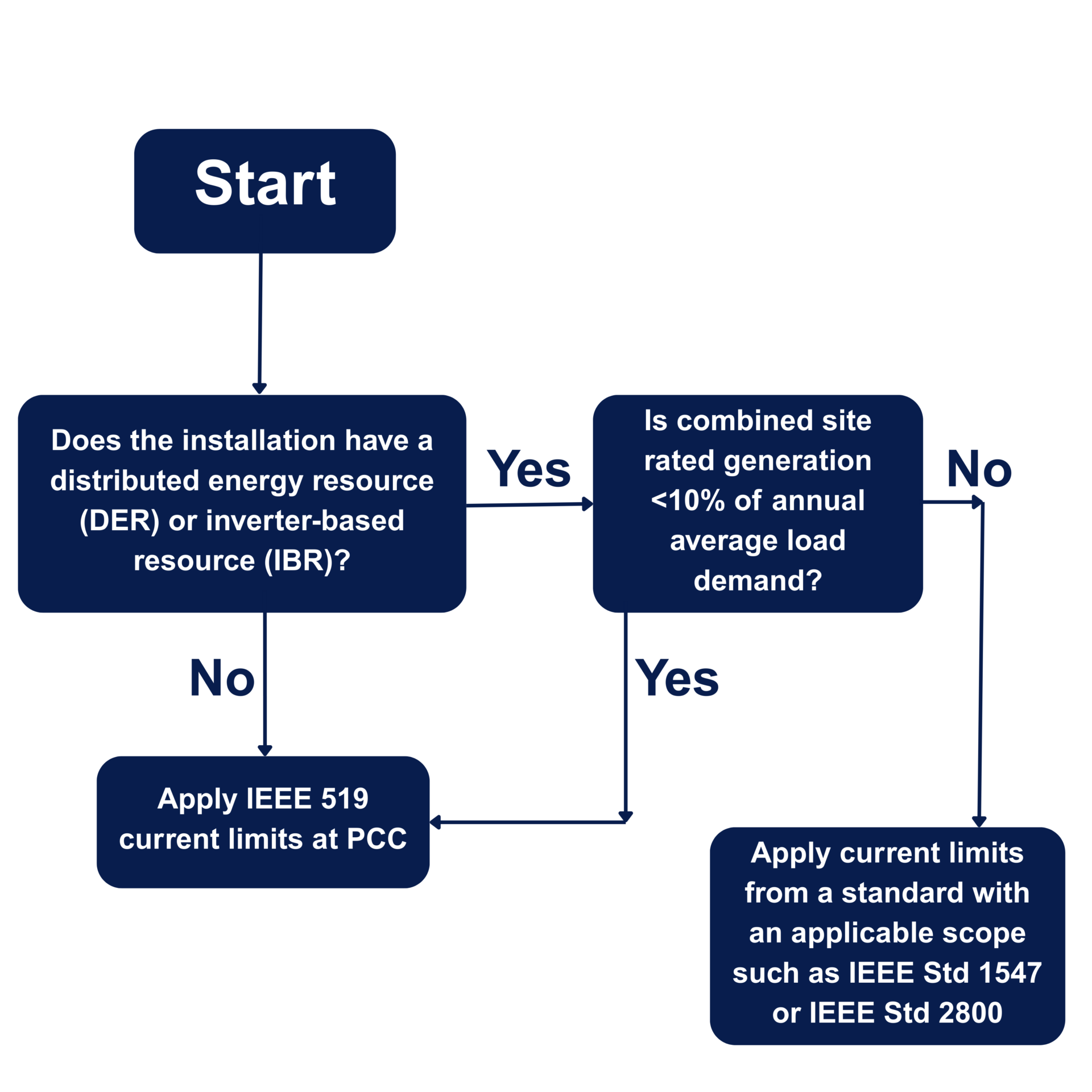
Figure 1: Decision tree for applying current distortion limits at PCC
Current distortion limits for systems rated 120 V through 69 kV
Table 1: Maximum Harmonic current distortion in percent of IL
Current distortion limits for systems rated 120 V through 69kV
| Maximum harmonic current distortion in percent of IL | ||||||
| Individual harmonic order (odd harmonics) a, b | ||||||
| ISC/IL | 3≤h<11 | 11≤h<17 | 17≤h<23 | 23≤h<35 | 35≤h≤50 | TDD |
| <20c | 4.0 | 2.0 | 1.5 | 0.6 | 0.3 | 5.0 |
| 20<50 | 7.0 | 3.5 | 2.5 | 1.0 | 0.5 | 8.0 |
| 50<100 | 10.0 | 4.5 | 4.0 | 1.5 | 0.7 | 12.0 |
| 100<1000 | 12.0 | 5.5 | 5.0 | 2.0 | 1.0 | 15.0 |
| >1000 | 15.0 | 7.0 | 6.0 | 2.5 | 1.4 | 20.0 |
a Even harmonics are limited to 25% of the odd harmonic limits above.
b Current distortions that result in a dc offset, e.g., half-wave converters, are not allowed.
c All power generation equipment is limited to these values of current distortion, regardless of actual ISC/IL.
where
ISC = maximum short-circuit current at PCC
IL = maximum demand load current (fundamental frequency component) at the PCC under normal load operating conditions.
Current THD Limits at the PCC
IEEE-519-2022 clarifies harmonic current evaluations by limiting the assessment range to the 50th harmonic order. This is explicitly defined in table 2 where the highest harmonic range considered is 35th≤h≤50th. This aligns the standard with common industry measurements practices and simplifies harmonic compliance assessments.
Voltage THD Limits at the PCC
Table 11-1 Voltage Distortion Limits in the 1992 version was updated (Table 1 in the 2014 version) with the addition of a new voltage range and limits.
A new lower PCC voltage range of V≤1.0kV was defined with higher allowable harmonic voltage limits: Individual Harmonic at 5% and Total Harmonic Distortion at 8%. These limits are higher than the next highest voltage range 1.0kV<V≤69kV.
High Frequency Current Allowance in Low Current Distortion Systems
IEEE 519-2014 provides for an allowance of higher high-order harmonic current limits at a PCC that has low lower-order harmonics. The allowance is applied to Table 2, Current Distortion Limits, if a prescribed minimum performance level is met.
For example, if a power system with Isc/IL< 20 has 5th and 7th harmonic currents at <1% then all other harmonic limits in Table 2 may be exceeded up to a factor of 1.4 and still be in compliance.
Measurements
The IEEE Std 519-2022 maintains the statistical measurement approach introduced in the previous revision by determining harmonic compliance. These methods will be especially useful for power systems with large amounts of cyclical loads or a power system with varying loads and distortion levels.
As described in more detail in the standard, the three statically based limit bands are:
- Daily 99th percentile harmonic currents should be less than 2 times the Current Distortion limits in Table 1
- Weekly 99th percentile harmonic currents should be less than 1.5 times the Current Distortion limits in Table 1
- Weekly 95th percentile harmonic currents should be less than 1.0 times the Current Distortion limits in Table 1
IEEE Societies
IEEESTD 519-2022 is developed under the transmission and distribution committee of the ieee power and energy society which maintains and updates the harmonic control standard for modern power systems.
Conclusions
IEEE Std519-2022 is the latest revision of IEEE standard for Harmonic Control in Electric power systems and supersedes IEEE std 519-2014. The standard continues to define clear responsibilities for utilities and users to control harmonic distortion at the Point of Common Coupling (PCC) while incorporating updates that reflect modern power systems, including the integration of inverter-based resources, clarified harmonic measurement practices, and updated voltage distortion limits.
Your system’s compliance with IEEE 519-2022 can be determined with the HarmonicGuard® Solution Center.
References
[1] “IEEE Recommended Practices and Requirements for Harmonic Control in Electrical Power Systems”, IEEE Std. 519-1992.
[2] “IEEE Recommended Practices and Requirements for Harmonic Control in Electrical Power Systems”, IEEE Std. 519-2014.
[3] “IEEE Standard for Harmonic Control in Electric Power Systems”, IEEE Std. 519-2022.